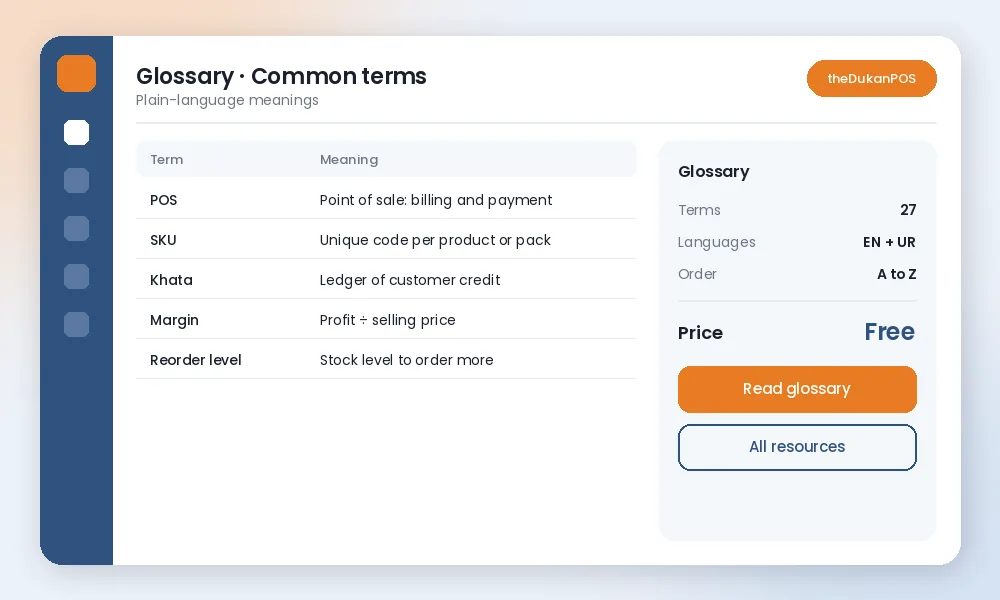
What is the POS meaning, and what do SKU, margin, khata or reorder level mean in a shop? This glossary explains common POS and retail terms in plain language for Pakistani shopkeepers.
From PKR 2,500/mo · USD $10/mo
POS means point of sale: where and how a sale is billed and paid.
Udhaar is credit given; khata is the ledger where you record it.
Margin is on selling price; markup is on cost.
Software, suppliers and accountants use these words every day. Knowing them helps you compare POS systems, read reports and price correctly. Terms are listed A to Z below; Urdu versions are on the Urdu glossary.
A pattern of lines (or a QR-style square) that a scanner reads to identify a product instantly at billing.
A machine that records sales and holds cash. Unlike a POS, it usually does not track stock or customers.
POS software that stores data online, so you can open it from a browser or app on different devices.
What you paid for an item, ideally including transport and loading.
The maximum udhaar you allow a customer before asking for payment.
Items that have not sold for a long time and tie up your money and shelf space.
The amount a customer pays upfront in an installment sale.
Sales minus the cost of the items sold, before rent, salaries and other expenses.
The items you have available to sell, and the records of how many you hold.
A document listing items, quantities, prices and the total a customer owes.
A ledger of customer credit (udhaar): what each customer owes and has paid.
A warning when an item falls below a level you set, so you reorder in time.
Profit as a percentage of the selling price.
Profit as a percentage of the cost price.
Running several shops or outlets from one account, with separate stock and sales for each.
The quantity of each item you have on the day you start using a system.
The place and the software where a sale happens: billing, payment and the receipt.
A list of items and quantities you order from a supplier.
Selling an item now and collecting the price in fixed monthly payments.
Proof of payment given to the customer, often printed on a thermal printer.
The stock quantity at which you should order more.
A tax added to the price of goods or services. Rates and rules depend on the item and province.
Stock keeping unit: a unique code for each product and size or pack.
A record of what you owe each supplier and what you have paid.
A small printer that prints receipts using heat-sensitive paper, with no ink.
Goods given on credit, to be paid later. Recorded in the khata.
Selling in bulk to other businesses, often at party-wise rates and on credit.
Want to see these ideas in practice? Read the getting started guide, try the free tools, or browse all resources.
POS stands for point of sale.
A cash register records sales; a POS also tracks stock, customers, credit and reports.
Stock keeping unit, a unique code for each product variant or pack.
Try every feature free for 15 days. Questions? Call or WhatsApp 0312 7032292 and talk to a real person.
