Udhaar recovery is one of the hardest parts of running a shop in Pakistan. Credit keeps regular customers loyal, and in many neighbourhoods a shop that refuses udhaar loses business. But money stuck with customers is money you cannot use to restock, pay suppliers or pay rent. A few thousand rupees here and there quietly becomes lakhs.
The good news is that most udhaar does come back when it is managed well. These twelve tips are about habits and systems, not arguments. They work whether you keep a paper khata, an Excel sheet or POS software.
1. Decide who gets udhaar, and how much
The easiest udhaar to recover is the udhaar you never gave to the wrong person. Keep credit for customers you know: neighbours, regular families, nearby businesses and staff of local offices. For a new face, start with cash and offer credit only after a few months of regular buying.
Set a credit limit for every customer. A daily-wage family might get Rs 3,000; a nearby workshop that pays monthly might get Rs 30,000. Write the limit next to the name and stick to it. When a customer reaches the limit, the conversation is easy: “Your limit is full, please clear some first.”
2. Record every entry, the same day
Disputes happen when records are unclear. Write each credit sale and each payment on its own line with the date, items or bill number and the amount. Never “remember to write it later”. If a family member or staff gives credit, they must write it too.
If you use a paper khata, ask the customer to initial large entries. If you use software, a bill attached to each credit entry ends most arguments. Our free khata template keeps a running balance for every customer automatically.
3. Agree a payment day upfront
“Pay whenever” usually means “pay never”. When you give credit, agree when it will be paid: on salary day, on the 1st of the month, every Friday, or when the harvest is sold. Write the day in the khata. Customers are far more likely to pay on a day they promised themselves.
4. Review balances every week
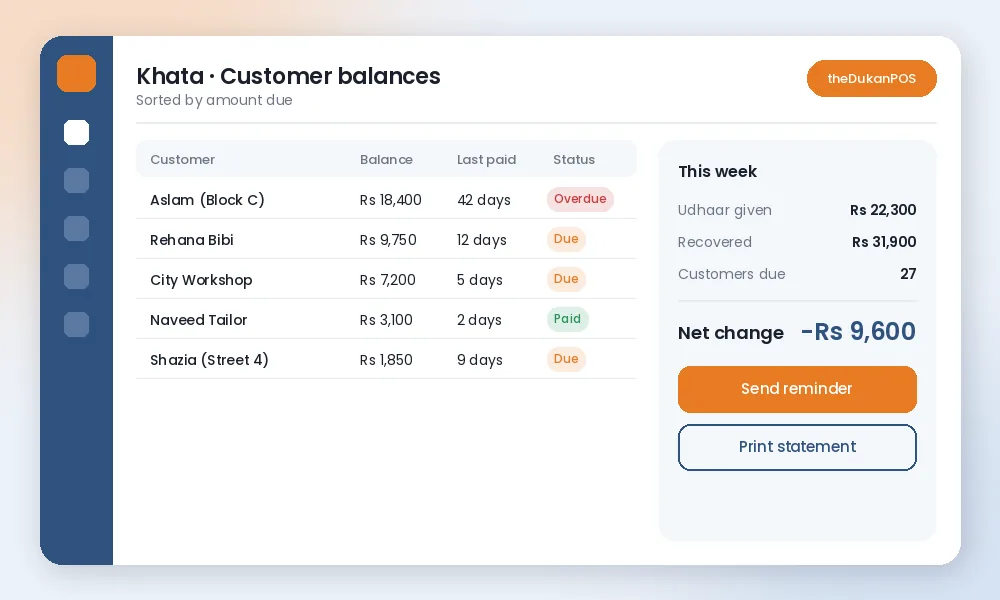
Pick one quiet hour each week, for example Monday morning, to go through every balance. Sort customers from highest to lowest balance and look at the date of their last payment. Anyone who has not paid in 30 days needs a reminder; anyone over 60 days needs a direct conversation.
This weekly review is the single most effective udhaar recovery habit. Problems are small when you catch them early.
5. Remind politely, privately and regularly
Most customers do not avoid paying on purpose; they forget, or other expenses come first. A polite private reminder works better than a public one. Mention the balance when they visit, quietly: “Bhai, your khata is at Rs 7,400. Can you clear some this week?”
A short phone call or WhatsApp message also works. Keep it friendly and specific: the amount, the last payment and a request for a date. Never shame a customer in front of others; you may recover the money but lose the customer and their family. Read our guide to using WhatsApp for your shop for message ideas.
6. Make it easy to pay something
A customer with a Rs 15,000 balance may feel it is impossible to clear and so pays nothing. Offer smaller steps: “Give Rs 2,000 every week.” Partial payments add up and keep the relationship alive. Always record each part payment and tell the customer the new balance.
7. Turn large balances into a simple plan
For a big balance, agree a written plan: amount per week or month, start date and what happens if a payment is missed. This is similar to how qist businesses work. A clear plan feels fair to the customer and gives you a fixed date to follow up.
8. Stop new credit until old credit moves
When a customer is over the limit or has not paid for a long time, pause new credit politely. Cash sales can continue. This one rule stops a small problem becoming a large loss, and most customers understand it.
9. Keep credit and cash separate in your head and your books
Udhaar is not sales until it is paid. If you count credit sales as income, you may think you are doing well while your cash drawer is empty. Track how much total udhaar is outstanding each week. If the total keeps rising, you are financing your customers with your own capital.
10. Watch your own suppliers
Your udhaar policy should match the credit you get from suppliers. If wholesalers want payment in 15 days but your customers take 60, the gap comes from your pocket. Try to negotiate longer supplier terms, or tighten customer credit, so cash flow stays balanced.
11. Know when to write off
Some money will not come back: a customer moves away, a business closes. After repeated attempts, decide whether chasing is worth more time. Mark the balance as written off in your records so your numbers stay honest, and do not give that customer credit again. Learn from each case: was the limit too high, or the review too late?
12. Use a system that shows balances instantly
The biggest reason udhaar gets out of control is that the shopkeeper does not know the exact balance at the moment of the sale. A system that shows the customer’s balance on the bill solves this. In theDukanPOS, khata is part of billing: choose the customer, the credit is added and the balance updates by itself. You can see who owes what at any time, and set the conversation up with facts rather than memory.
Common udhaar recovery mistakes
Avoid these habits, which make recovery harder: giving credit without writing it down “because he is a regular”; letting several family members give credit with no shared record; reminding only when you are angry; accepting payments without updating the balance in front of the customer; and raising a customer’s limit just because they asked. Each one makes the balance less clear, and unclear balances are the ones that never get paid.
A simple udhaar recovery routine
- Daily: record every credit sale and payment the same day.
- Weekly: review balances, remind anyone over 30 days.
- Monthly: check total udhaar against last month; pause credit for anyone over limit.
- Every few months: review limits, agree plans for large balances, write off what is truly lost.
If you are thinking about moving from paper, see how a register compares with a POS or read how to keep shop accounts.
Frequently asked questions
What is the best way to recover udhaar from customers?
Combine clear records, credit limits and polite weekly reminders. Agree a payment day when giving credit, accept partial payments, and pause new credit until old balances move.
How much udhaar should a shop give?
There is no single number. Set a limit per customer based on how well you know them and how they pay, and watch the total udhaar against your own supplier credit.
Should I charge extra on late udhaar?
Many small shops do not. If you want to, agree it clearly in advance; surprise charges damage trust.
Can POS software help with udhaar recovery?
Yes. A POS with khata shows each customer’s balance on every bill and lists who owes the most, which makes reminders faster and based on facts.