Selling on qist (installments) brings customers who cannot pay the full price today: a motorcycle for work, a fridge before summer, furniture for a wedding, or a phone for a student. It also brings risk. Months later, people forget what was agreed: the total price, the monthly amount, the due date or what happens when a payment is late. A clear written installment agreement protects both the seller and the buyer.
This guide explains what an installment agreement format should contain, gives a sample layout you can adapt, and lists the checks to do before handing over the product. It is general guidance, not legal advice. For high-value sales or if you are unsure, ask a local lawyer to review your format once and then reuse it.
Why a written qist agreement matters
- No disputes about the price. The total qist price, advance and monthly amount are written and signed.
- Clear due dates. The customer knows exactly when each instalment is due.
- Guarantor accountability. A guarantor who signed is far more likely to help when payments stop.
- Proof if things go wrong. A signed agreement with identity copies is your evidence if you ever need to involve elders, a panchayat or the courts.
What to include in an installment agreement
1. Parties and identity
Write the shop name, address and owner name, and the buyer’s full name, father’s or husband’s name, CNIC number, address and mobile number. Keep a photocopy of the CNIC (front and back) and a recent photo. Many shops also note the buyer’s workplace and a second phone number.
2. Product details
Describe the product precisely: brand, model, colour and any serial number. For motorcycles, write the engine and chassis numbers; for phones, the IMEI; for appliances, the serial number. This matters if there is ever a question of which item was sold.
3. Price and payment plan
Write the cash price for reference, the total installment price, the advance (down payment), the number of instalments, the monthly amount and the due date each month. Many shops in Pakistan sell at a fixed total price agreed upfront rather than charging interest; whatever model you use, the total amount payable should be written as one clear figure so there is no confusion later.
4. Payment method and receipts
State where and how payments are made (at the shop, by bank transfer or by a recovery officer) and that a receipt will be given for every payment. Receipts protect the customer and stop arguments about whether a month was paid.
5. Late payment terms
Explain what happens if an instalment is late: a reminder after a few days, a visit or call to the guarantor, and what happens after repeated missed payments. Keep these terms reasonable and lawful, and apply them consistently. Surprise penalties damage trust and may not be enforceable.
6. Ownership and possession
Write who owns the product until the final payment. Some sellers keep the original documents (for example, a motorcycle’s registration file) until the last instalment is paid, and hand them over with a clearance letter. Write this clearly so the buyer knows when documents will be released.
7. Guarantor details
Most qist sellers ask for one or two guarantors. Record each guarantor’s name, CNIC, address, phone number and relationship to the buyer, and have them sign. A guarantor should understand that they are responsible if the buyer stops paying.
8. Early settlement
Say whether the buyer can pay off the balance early and whether any discount applies. Customers appreciate knowing this upfront.
9. Signatures, date and witnesses
The seller, buyer and guarantors sign and date the agreement, ideally with thumb impressions too. Two witnesses are common. Many sellers print the agreement on stamp paper for higher-value items; check locally what is customary for your product and amount.
Sample installment agreement format
Use this as a starting layout and adjust it to your business:
- Title: Installment Sale Agreement / اقساط پر فروخت کا معاہدہ
- Agreement no. and date
- Seller: shop name, address, owner name, phone
- Buyer: name, father/husband name, CNIC, address, phone, workplace
- Product: brand, model, colour, serial/IMEI/engine and chassis number
- Price: cash price, total installment price, advance, balance
- Plan: number of instalments, monthly amount, due date each month, first due date
- Payments: place and method; receipt for every payment
- Late payment: reminder, guarantor contact, steps after repeated delays
- Ownership/documents: when documents are handed over
- Early settlement: allowed or not, and any discount
- Guarantor 1 and 2: name, CNIC, address, phone, relationship, signature
- Signatures: seller, buyer, guarantors, two witnesses, thumb impressions
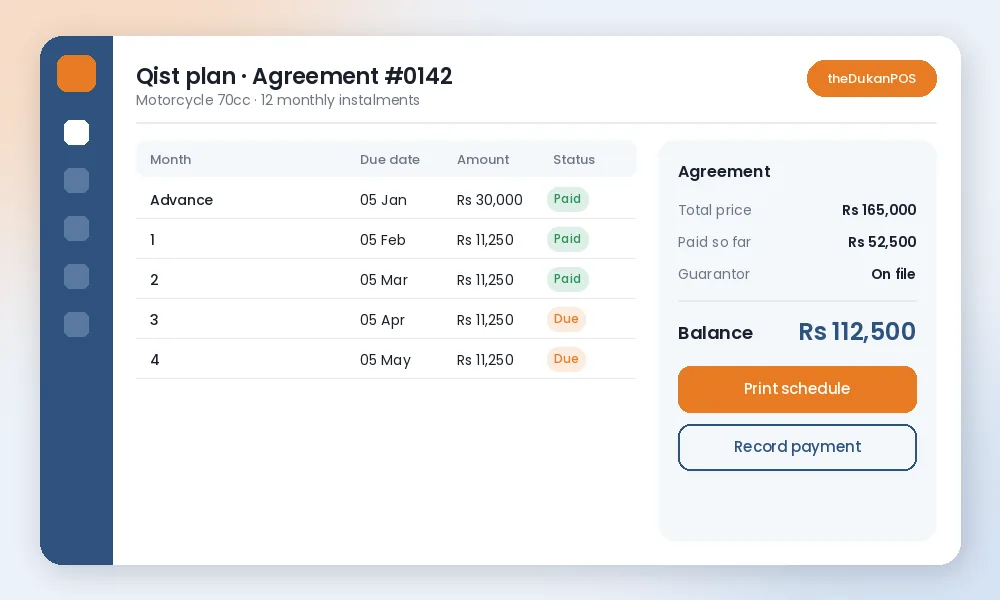
Attach the payment schedule (month, due date, amount) as a second page, and give the customer a copy of both pages.
Checklist before handing over the product
- CNIC copies of the buyer and guarantors taken and checked against the originals.
- Phone numbers verified by calling them in front of you.
- Advance received and a receipt issued.
- Serial, IMEI or engine/chassis numbers written correctly.
- Every page signed; the customer has a copy.
- The plan entered in your installment register or software the same day.
Common mistakes to avoid
- Writing only the monthly amount. Always write the total installment price too, so the customer cannot later claim a lower total.
- Blank spaces. Fill every field or strike it out before signing; blanks can be filled in later by anyone.
- One copy only. Give the buyer a signed copy and keep the original; it builds trust and avoids accusations.
- Guarantors who never met you. Meet each guarantor, check the original CNIC and call their number before accepting them.
- Changing terms verbally. If you agree to move a due date or reduce an instalment, write it on the agreement or schedule and have both sides initial it.
Keep the schedule, not just the paper
The agreement is only the start. Most qist businesses lose money not because the agreement was weak but because nobody noticed missed payments early. Keep a schedule for every customer and check it daily: who is due today, who is overdue and by how many days. Use our free installment calculator to work out the monthly amount and schedule before you write the agreement.
theDukanPOS includes installment tracking for shops that sell on qist: plans with advance and monthly amounts, due and overdue lists, and payment history per customer. If you sell motorcycles, appliances or furniture, see our page for installment showrooms and our guide on how to manage a qist business.
Frequently asked questions
What is an installment agreement?
A written agreement between a seller and a buyer that records the product, the total price, the advance, the monthly instalments, due dates, late payment terms and guarantors, signed by everyone involved.
Does a qist agreement need stamp paper?
It is common for higher-value items, but practice varies. Check what is customary locally, and ask a lawyer to review your format if the amounts are large.
How many guarantors should I ask for?
Many qist sellers ask for one or two guarantors with CNIC copies and phone numbers. Choose based on the value of the item and how well you know the customer.
Can I make an installment agreement in Urdu?
Yes. Many shops use an Urdu or bilingual agreement so the buyer and guarantors fully understand what they are signing.